.png)
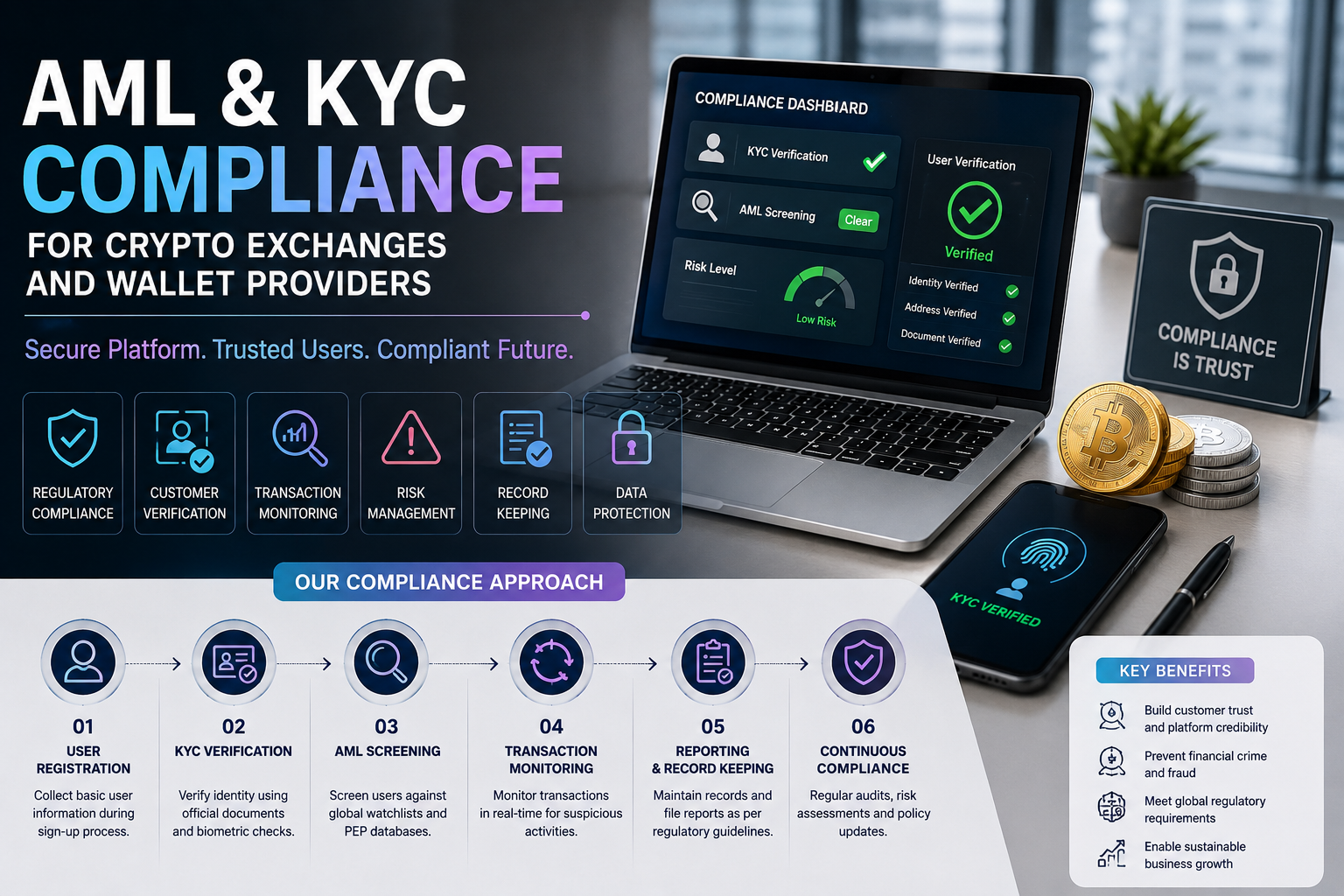
As the cryptocurrency industry continues to evolve, regulators across the world are placing greater emphasis on AML (Anti-Money Laundering) and KYC (Know Your Customer) compliance. Whether you operate a crypto exchange, custodial wallet, OTC desk, or virtual asset platform, implementing a strong compliance framework is no longer optional—it’s an essential part of running a sustainable business.
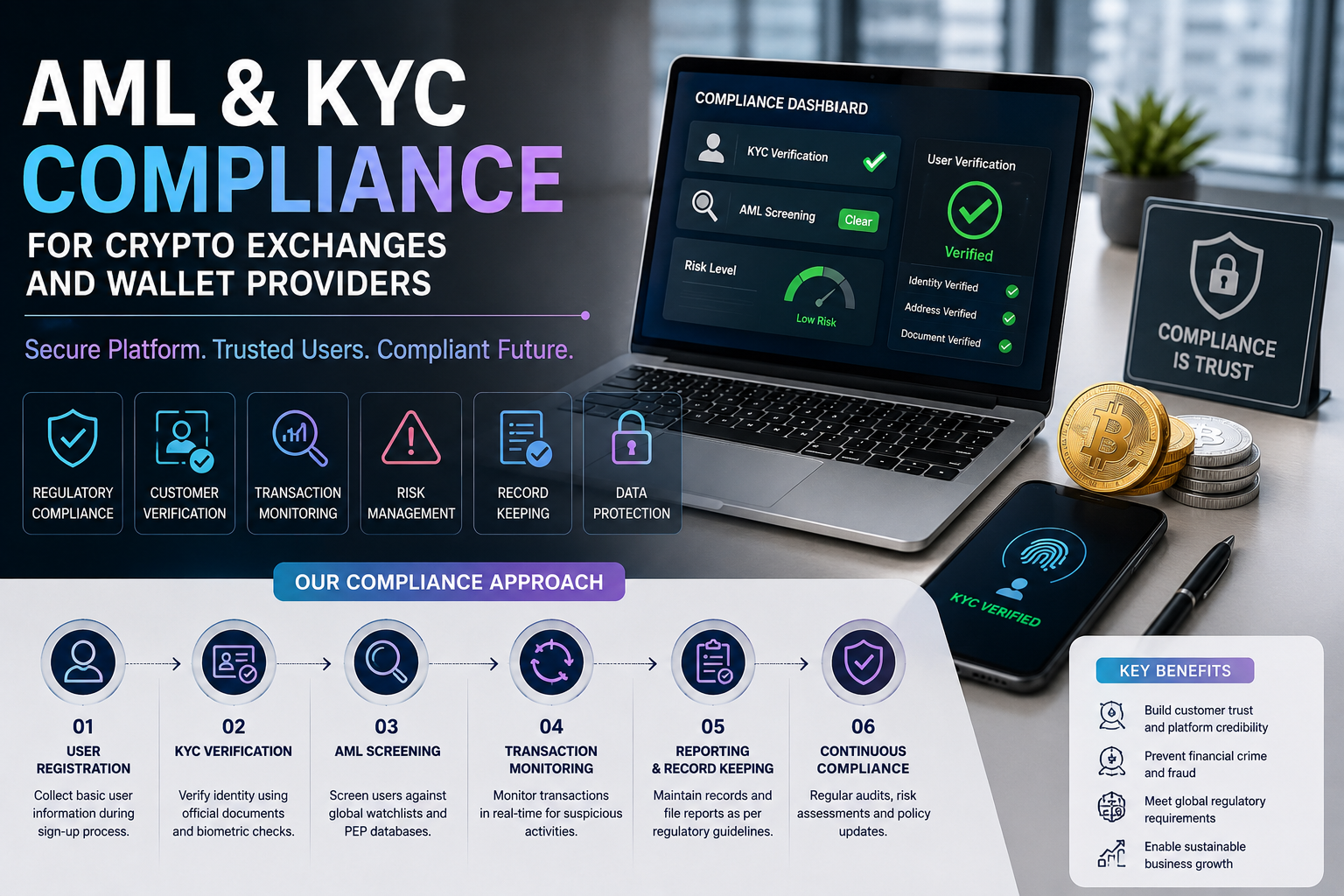
Banks, payment partners, investors, and regulators increasingly expect crypto businesses to demonstrate that they have effective controls to prevent financial crime, terrorist financing, sanctions violations, and fraud.
In this guide, we’ll explain what AML and KYC compliance means for crypto exchanges and wallet providers, the key requirements, practical implementation steps, and answers to frequently asked questions.
What is AML Compliance?
Anti-Money Laundering (AML) refers to the policies, procedures, and internal controls designed to prevent criminals from using financial systems to conceal illegally obtained funds.
For crypto exchanges and wallet providers, AML compliance involves identifying suspicious transactions, monitoring customer activity, reporting unusual behaviour where required, and maintaining proper records.
An effective AML framework helps protect both the business and its customers while reducing regulatory risk.
What is KYC Compliance?
Know Your Customer (KYC) is the process of verifying the identity of customers before allowing them to use regulated financial services.
The objective is to ensure that customers are genuine, understand who is using the platform, and reduce the risk of fraud, money laundering, and sanctions violations.
A standard KYC process may include:
- Identity verification
- Address verification
- Selfie or biometric verification
- Source of funds information (where appropriate)
- Risk assessment
- Ongoing customer monitoring
Why AML and KYC Matter for Crypto Businesses
Crypto businesses operate in a fast-moving global environment where digital assets can be transferred across borders within minutes. Without appropriate compliance controls, exchanges and wallet providers may become vulnerable to financial crime at DAOs.
Implementing a robust AML and KYC program can help:
- Meet regulatory obligations.
- Build trust with customers and institutional partners.
- Reduce fraud and account abuse.
- Improve banking relationships.
- Support licensing and registration applications.
- Strengthen investor confidence.
- Minimise legal and reputational risks.
Today, AML compliance is often viewed as a competitive advantage rather than simply a regulatory obligation.
Who Needs AML and KYC Compliance?
AML and KYC requirements commonly apply to:
- Cryptocurrency exchanges
- Custodial wallet providers
- Virtual Asset Service Providers (VASPs)
- OTC crypto trading desks
- Crypto payment processors
- Stablecoin platforms
- Token service providers
- Digital asset custodians
Even businesses operating internationally should carefully assess the compliance requirements in every jurisdiction where they provide services at Web3 compliance.
Key AML and KYC Requirements
Although requirements vary between jurisdictions, most regulators expect crypto businesses to implement a comprehensive compliance program.
Typical requirements include:
Customer Identification
Verify customer identity before providing regulated services.
Customer Due Diligence (CDD)
Collect sufficient information to understand customer risk profiles.
Enhanced Due Diligence (EDD)
Apply additional checks for higher-risk customers, large transactions, or Politically Exposed Persons (PEPs).
Transaction Monitoring
Monitor transactions for unusual or suspicious activity using risk-based controls.
Sanctions Screening
Screen customers against international sanctions lists and watchlists.
Record Keeping
Maintain customer records and transaction histories for the period required by applicable regulations.
Suspicious Activity Reporting
Where required by law, report suspicious transactions to the relevant financial intelligence authority.
Step-by-Step AML and KYC Compliance Process
Establishing an effective compliance framework requires more than simply collecting identity documents.
Step 1: Conduct a Risk Assessment
Evaluate your business model, customer base, jurisdictions, products, and transaction types to identify potential AML risks.
Step 2: Develop Internal Policies
Prepare documented policies covering:
- AML Policy
- KYC Procedures
- Customer Due Diligence
- Enhanced Due Diligence
- Sanctions Screening
- Record Retention
- Suspicious Transaction Reporting
Step 3: Implement Identity Verification
Adopt reliable identity verification procedures before onboarding new customers.
Step 4: Monitor Transactions
Use automated and manual monitoring processes to identify unusual transaction patterns or high-risk behaviour.
Step 5: Train Employees
Ensure employees understand AML obligations, reporting procedures, and compliance responsibilities.
Step 6: Perform Ongoing Reviews
Compliance is an ongoing process. Regularly review customer profiles, update policies, and conduct internal audits.
Common AML and KYC Mistakes
Many crypto startups focus heavily on technology while overlooking compliance infrastructure.
Some common mistakes include:
- Weak customer onboarding procedures.
- Relying solely on manual verification.
- Failing to update AML policies.
- Ignoring sanctions screening.
- Inadequate transaction monitoring.
- Poor documentation and record retention.
- Delayed reporting of suspicious activity.
Building compliance into your operations from the beginning is often more efficient than trying to retrofit controls after launch.
Best Practices for Crypto Exchanges
To strengthen AML and KYC compliance, consider the following best practices:
- Adopt a risk-based compliance approach.
- Keep customer information up to date.
- Review high-risk accounts more frequently.
- Maintain clear internal reporting procedures.
- Conduct regular compliance training.
- Perform periodic independent compliance reviews.
- Monitor regulatory developments across all operating jurisdictions.
Strong governance and documentation are just as important as technology.
Frequently Asked Questions (FAQs)
Is KYC mandatory for crypto exchanges?
Many jurisdictions require regulated crypto exchanges and Virtual Asset Service Providers (VASPs) to implement KYC procedures. The exact obligations depend on the applicable regulatory framework.
Do wallet providers need AML compliance?
Custodial wallet providers and businesses that manage customer assets often have AML and KYC obligations, although requirements vary depending on the jurisdiction and business model.
What is Customer Due Diligence (CDD)?
CDD is the process of verifying customer identity, understanding the nature of the business relationship, and assessing the customer’s risk profile.
How often should customer information be reviewed?
Customer information should be reviewed periodically, particularly for higher-risk customers or where significant changes in activity occur.
Can AML compliance be outsourced?
Many businesses use third-party compliance technology for identity verification and transaction monitoring. However, the responsibility for regulatory compliance generally remains with the business itself.
Final Thoughts
The crypto industry continues to mature, and regulatory expectations are evolving alongside it. For crypto exchanges and wallet providers, AML and KYC compliance should not be viewed as a regulatory burden but as a fundamental part of operating a secure and trustworthy platform.
Businesses that invest in effective compliance frameworks are often better positioned to secure banking relationships, obtain licences, attract institutional clients, and expand internationally.
A proactive approach to AML and KYC not only reduces regulatory risk but also strengthens long-term business credibility in an increasingly regulated digital asset ecosystem.
Need Help with AML and KYC Compliance?
Whether you’re launching a crypto exchange, digital wallet, payment platform, or other Virtual Asset Service Provider (VASP), having a robust compliance framework is essential for long-term success.
At Your Tech Legal, we advise crypto exchanges, blockchain startups, fintech companies, and Web3 businesses on AML/CFT compliance, KYC frameworks, VASP registration, licensing, risk assessments, internal compliance policies, and cross-border regulatory requirements platform-governance.
If you’re planning to launch or scale your crypto business, our team can help you design a practical compliance strategy tailored to your operations and the jurisdictions in which you operate.
Contact Your Tech Legal today to discuss your AML and KYC compliance requirements.
