.png)
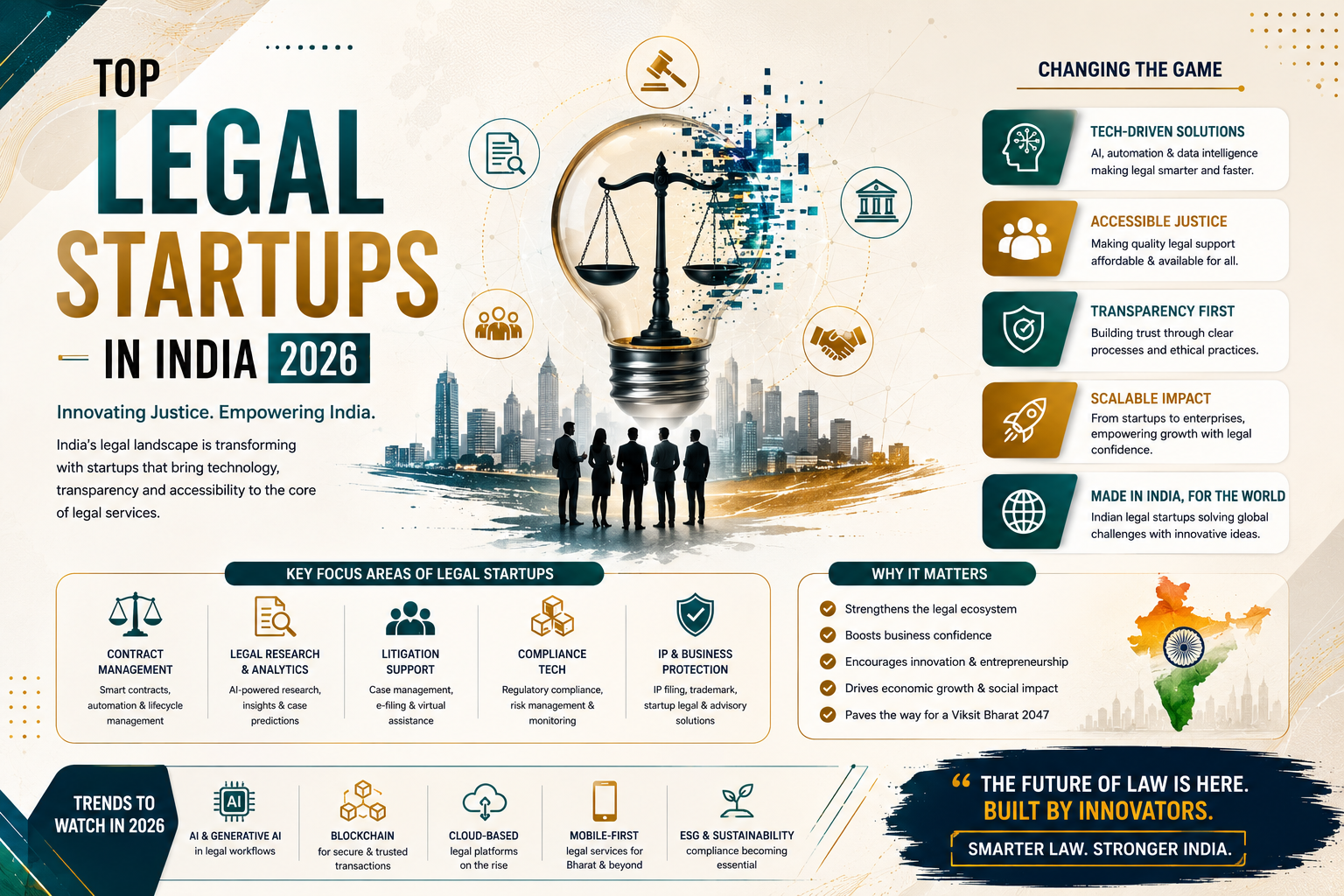
Top Legal Startups in India 2026
Top Indian Legal Tech Startups Indian Legal Tech startups are transforming the traditional legal services with artificial intelligence and digital instruments. They assist in preparing contracts, expediting legal research, automating the resolution of disputes, and providing access to online professional consultation. Two such innovations, digitising paperwork and streamlining client communication, make legal help much faster, cheaper and more reliable for everyday citizens and businesses alike.
Introduction
A new wave of legal tech startups is changing that reality today with artificial intelligence, cloud software and online platforms. These legal tech platforms are built for legal practitioners and the public. Whether it’s the small business owner who needs a fast contract review, or the individual who needs affordable legal advice, modern tech solutions are bridging the gap between clients and justice. They automate legal workflows that are repetitive, improve the accuracy of documents, and speed up dispute resolution procedures nationwide.
And with digital adoption only increasing, it’s important to understand how these legal solutions work. By replacing slow manual tasks with smart automation. India’s legal technology sector is making justice faster, more transparent and remarkably easy to navigate for everyone involved at tech legal.
Table of Contents
Introduction
Transformation of Tech Legal Startups
Key Categories of Legal Tech Solutions Driving Industry Growth
Comparison Table
Example
Expert Tip
Common Mistakes
Conclusion
Transformation of Tech Legal Startups
The traditional legal framework in India has been associated with endless paperwork, physical visits to chambers and lengthy delays that too from a long period of time. Digital technology platforms are dismantling these barriers by introducing smart automated systems designed to streamline every step of the legal journey at tech law firms.
One of the most apparent effects is the speed of document handling. What took senior associates hours of careful reading now happens almost instantaneously. This dramatic reduction in labour hours reduces total costs for clients, freeing up legal professionals to focus on high-level strategic advice.
Also, the availability of quality legal advice has improved with digital platforms. Locals in non-metro areas no longer must go to big cities to see qualified legal specialists. Secure web applications allow people to verify identity documents, to book video consultations and to get legally valid advice from the comfort of their homes.
Virtual dispute resolution mechanisms assist in resolving commercial and consumer conflicts beyond jammed courtrooms. They facilitate structured negotiation rooms and digital arbitration systems that reduce friction between opposing parties. This transition to digital efficiency is creating an accountable, transparent and user-friendly legal ecosystem all over India.
Best Legal Tech Solutions to Grow Your Practice
The Indian legal tech space is characterized by several niche categories, each tackling specific pain points in the legal industry.
First, contract life cycle management tools deal with the whole life cycle of an agreement. These platforms enable users to create, negotiate, electronically sign and file legally binding agreements easily. Small business owners can now access built in template libraries to generate custom agreements, non-disclosure forms and employment letters without having to pay high drafting fees each time.
Second, legal research and analytics platforms enable advocates and legal departments. Such AI-enabled search engines can read decades of judicial rulings, statutes, and case laws in seconds. Legal teams can now rely on accurate case precedents and predictive insights on likely judgment outcomes based on previous judicial trends instead of manual digest books.
Thirdly, online legal market aggregators simplify the process of linking clients with certified advocates directly. These sites offer verified profiles of practitioners, transparency in fees, and verified client ratings that take out the guesswork of finding trustworthy representation.
Finally, growing businesses can remain compliant with statutory needs through regulatory compliance and intellectual property management solutions. They track filing deadlines, manage trademark registrations, and automate corporate filings to protect businesses from costly penalties and administrative legal errors.
The founder uses modern legal tech tools to pull up customized contract templates, generate binding agreements in under ten minutes, and electronically submit trademark registration forms. Months later, a small payment dispute with a supplier is settled between the parties on an online dispute platform, without the need to set foot in a court.
Comparison Table
|
Feature |
Traditional Legal Method |
Startup Tech Solution |
|
Document Creation |
Manual drafting taking days |
Automated templates in minutes |
|
Books and manual reading |
AI searching past judgements |
|
|
Finding Advocates |
Peer to peer recommendations |
Online verified directory matching |
|
Dispute Resolution |
Multiyear courtroom litigation |
Online dispute resolutions within weeks |
Expert Tip
Pick a digital legal platform that is encrypted well, adheres to existing data privacy laws, and is able to authenticate documents. Technology should make your legal paperwork easier. Platform security protocols make sure your sensitive legal agreements are 100% private, valid and enforceable in court.
Common Errors
- Data Security Overlooked in Corporate Confidential Legal Files Uploaded to sites without end-to-end encryption of data.
- Skipping human legal review: Using automated tools alone, without a qualified lawyer reviewing final high-stakes agreements.
- Assumes all electronic signatures have the same legal standing without verifying official e signature compliance. Confuses Virtual Signatures.
- Not adhering to the platform’s compliance by using legal tools that are not in line with the latest central data privacy frameworks.
FAQ
Q1: What is legal tech?
Legal tech solutions are digital instruments, software applications, and online platforms that help automate, simplify, and improve legal tasks. They assist both citizens and legal professionals with such things as contract creation, legal research, lawyer consultation, e-signatures, and regulatory compliance. They make legal services faster, more transparent, and considerably more affordable to all.
Q2: Are electronic signatures online legally valid in court?
Yes. Under Indian laws of cyber a digital signature is valid if it is created by a compliant software. They are legally the same as traditional ink signatures if the platform has proper identity verification processes in place. However, certain specific documents such as property transfers, wills and power of attorney still need to be executed and registered in physical form as per law.
Q3. Will real lawyers be replaced by software programs?
No, digital software cannot replace experienced human advocates. Technology is good at automating repetitive work like drafting boilerplate contracts and sifting thru case documents. That’s not to say that any of those skills are easy to develop – complex litigation, courtroom advocacy, strategic negotiation and nuanced legal strategy all require sound judgment, empathy and professional ethics, qualities only experienced legal experts can bring to the table.
Q4. What is the procedure for online legal advice portals?
The online legal portals use web applications to connect users with verified legal practitioners. Users can choose for lawyers by location, area of expertise, language and consultation fee. Clients securely upload the relevant documents and have the consultation by audio or video call that way they receive professional legal advice without having to struggle with going to some office.
Q5. What is Online Dispute Resolution?
Online Dispute Resolution is a process to resolve disputes outside the traditional courts through negotiation, mediation, or arbitration that is done online. Parties file claims online, file evidence online, and interact with a neutral mediator virtually. It saves a lot of time and money. It is perfect for effectively handling commercial, consumer, and financial disputes.
Q6: How can automated tools help small businesses save money?
Small businesses save money on basic administrative legal work as they don’t have to pay expensive hourly legal fees. Automated platforms for instant access to compliant contract templates, non-disclosure agreements and employment letters. This enables entrepreneurs to handle their routine legal affairs independently and spend money on specialized lawyers only when they have to deal with complex issues.
Summary
India’s legal services sector is moving toward a permanent digital transformation. Artificial intelligence, cloud computing, online dispute resolution these and other innovations are eliminating classical legal obstacles, providing expert legal assistance to citizens of all social strata.
These electronic devices provide individuals and small businesses with unprecedented convenience, cost effectiveness, and speed. What once took weeks of routine work can now be done with a few clicks. Users can protect their legal rights without daunting administrative hurdles. At the same time, legal professionals are using these technologies to eliminate tedious paperwork, and to provide better quality and more value-added services to their clients.
Modern legal tech solutions are no longer just a trend, but rather the standard way to handle legal affairs. As technology matures, the combination of automation and professional expertise will create a fairer, faster and much more transparent legal ecosystem for all of India.
