.png)
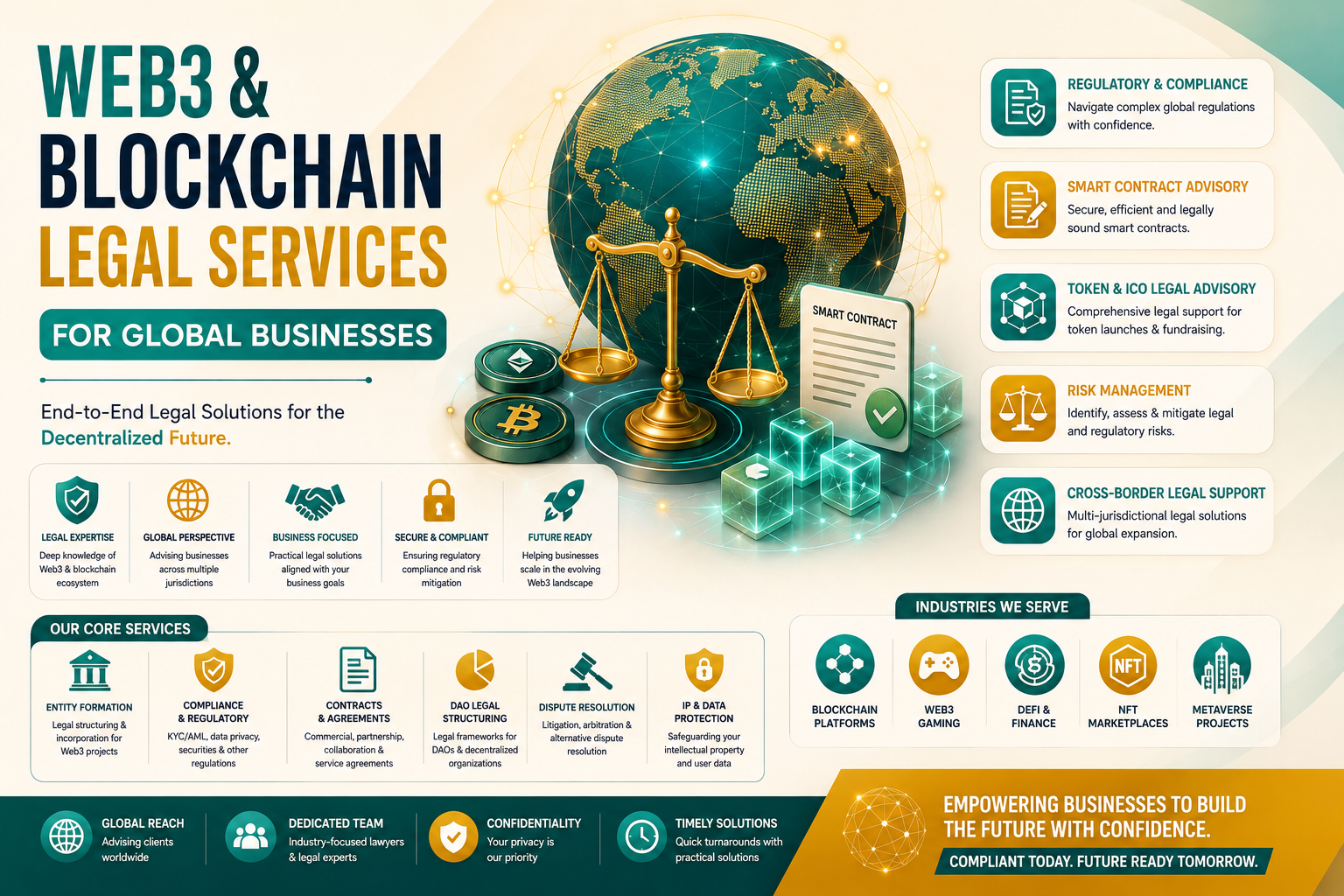
Many of the global Businesses crypto laws are often viewed as complex due to their fast-moving nature, making the launch of tokens, decentralized entities (including DAOs), and other crypto-related initiatives a challenge. Web3 legal services provide the necessary support, including drafting token legal opinions, obtaining local permits, and even smart contract audits, to ensure businesses are legally compliant and avoid regulatory scrutiny and unnecessary fines when expanding.
Introduction:
Launching a blockchain business in the midst of an international legal storm can be a frustrating experience, to say the least. The fast-paced nature of the Web3 ecosystem has made many of its tools integrate with FinTech and formalize the sector, creating an even denser tangle of global restrictions. Even the best of conventional corporate lawyers find it difficult, and frankly impossible, to provide legal support in the face of smart contracts, tokenomics, and global decentralized governance at Legal Services.
Specialized Web3 legal teams are equipped and prepared to make it possible for you to launch actual digital asset products with peace of mind. Providing legal support in crypto-friendly jurisdictions is just the beginning of the protection they provide your project. They also ensure your token design is compliant and won’t be construed as an illegal security, among many other things.
By working with actual legal professionals, you have the opportunity to expand your product to international markets, raise capital, and launch your project whenever you are ready to do so.
Table of Contents:
What Web3 Lawyers Actually Do
Navigating Global Crypto Regulations
Traditional Corporate Law vs. Web3 Legal
Real World Example
Pro Tip for Web3 Founders
Common Legal Pitfalls
FAQs
Wrapping Up
What Web3 Lawyers Actually Do
Web3 lawyers are at the intersection of code and finance law. Web3 lawyers change the legal language to explain the tech to the regulators.
Here’s what Web3 lawyers do:
- Token Structuring & Legal Opinions: Lawyers draft tokens that are not considered to be unregistered securities and provide legal opinions so crypto exchanges will list the tokens.
- DAO Wrappers & Governance: In order to protect the core developers from liability for governance issues, lawyers create legal entities around decentralized communities.
- Smart Contract Legal Audits: They draft off-chain agreements and TOS and ensure legal compliance for the smart contracts.
- VASP Licensing & Compliance: They will register the business as a Virtual Asset Service Provider and create automated KYC/AML that will meet the global standards for banking and finance.
Navigating Global Crypto Regulations
One token can create legal issues in many jurisdictions because of the borderless nature of blockchains. What is legal in one jurisdiction can result in a shutdown in another.
European frameworks like the MiCA, have specific and clear guidelines for token issuers and wallet services in each of the member states. Adding to the complexity of the legal landscape, in the US a more aggressive framework is taking charge, while countries like the UAE, Singapore, and Switzerland are becoming more progressive and clarifying their own regulations.
Web3 specialized lawyer teams use multi-entity frameworks to split software, tokens, and IP holdings across different jurisdictions at Legal Services.
Real World Example: A European Web3 game studio wanted to allow its players across North America and Asia to use a utility token. The game studio Crypto specialized lawyer teams to do the setup. The lawyers provided the token with a positive legal classification, created a Caymans based foundation wrapper for DAO governance, and completed the European statements of regulatory compliance. The setup was done in multiple jurisdictions to allow the game studio to raise $15 million without any conflicts of international securities laws.
Web3 Founders Tip: Always obtain a formal Legal Opinion prior to a token launch. Regulators are interested in the token economics, your staking rewards, marketing, and more. They will not be satisfied with the information in your white paper.
Common Legal Mistakes:
Using generic copy-pasted corporate templates for Web3 products.
Believing that calling something a “utility token” will provide a legal shield from financial laws.
Running a DAO with no legal wrapper, thus, leaving all of the DAO governors legally exposed.
Disregarding the global FATF Travel Rule for crypto transfers.
Forgetting to match your smart contract with your on-line Terms of Service.
Copying legal disclaimers of another project with no customization for your legal jurisdictions.
FAQs:
What are Web3 legal services?
Web3 Legal services are legal services with a focus on the advisory of legal crypto regulations, token launch, smart contract, DAO, and cross-border digital asset legal services.
Why can’t I hire a normal corporate lawyer?
The traditional lawyer simply will not understand things like tokenomics, smart contract code, or decentralized governance. Web3 law deals with the intersection of advanced technologies and multi-jurisdictional compliance systems.
What is a token legal opinion?
A token legal opinion is a written legalistic opinion provided by crypto lawyers that assesses whether or not your token can be considered a security, utility, or payment token under various jurisdictions.
How do Web3 lawyers deal with European MiCA rules?
Web3 lawyers assist crypto projects with the preparation of compliant whitepapers, registration as crypto service providers, and compliance with the EU customer protection and reserve management rules.
Can DAO contributors be sued?
Yes. Without a legal wrapper, a DAO is generally treated by the courts as an informal partnership and members may be liable for its debts and any resulting damages.
What is the crypto Travel Rule?
The crypto Travel Rule is a compliance framework that requires crypto firms to collect and disseminate specific sender and recipient information for value transfers that exceed a defined threshold.
How much do Web3 legal services cost?
Prices range considerably depending on the type of services requested. The cost can be as low as $5,000 for basic legal services and $100,000 and above for complex legal multi-jurisdictional token launches and financial licensing.
Conclusion
Web3 and digital assets regulations are evolving rapidly and trying to save costs on legal compliance may be one of the most effective ways to kill a project with real potential. Engaging a legal team that is knowledgeable in blockchain technology and law will provide the necessary assurances to legal compliance for a project to operate in a global market.
