.png)
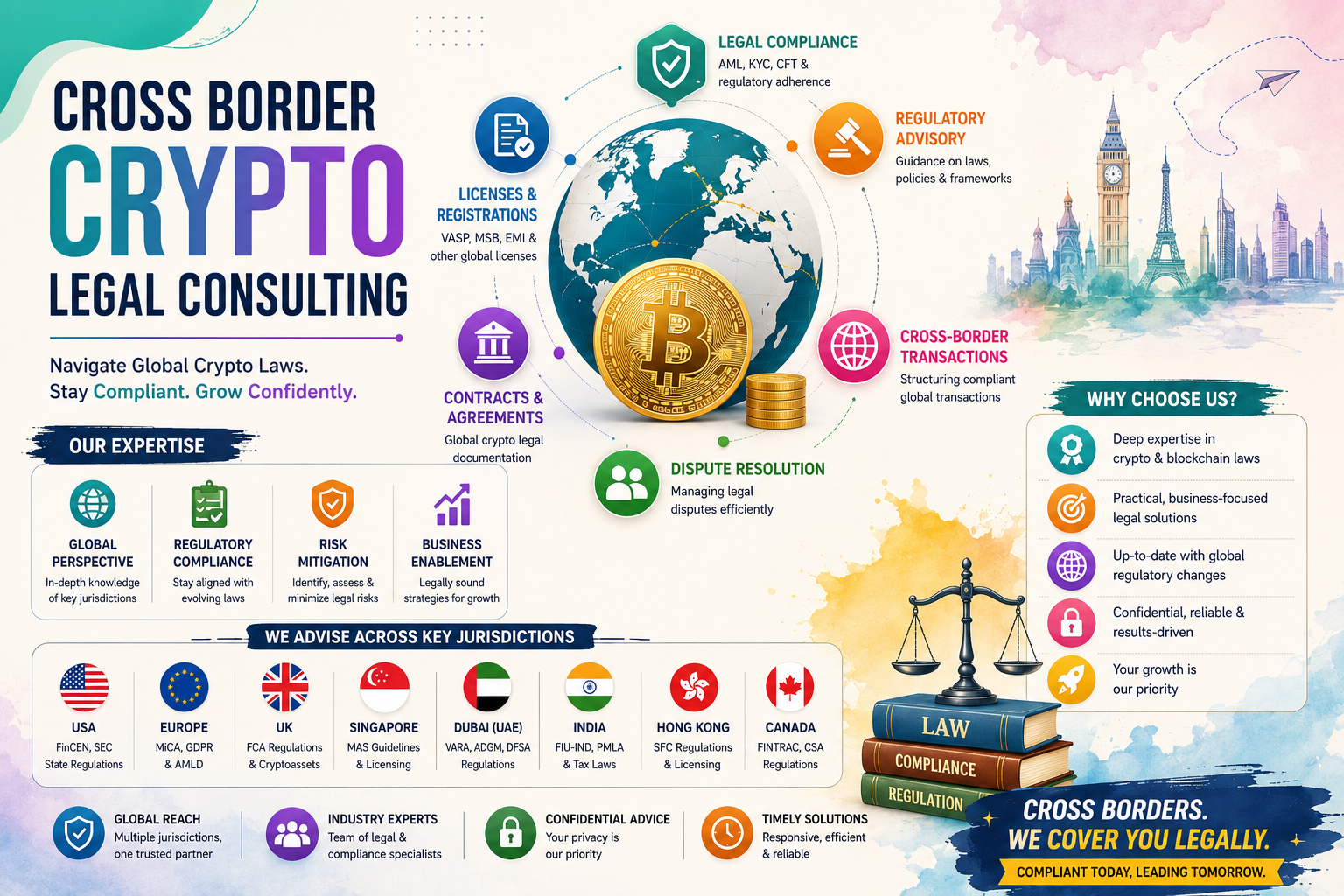
When you trade in cryptocurrency you do not look at the borders of the countries but law does. Different laws are applicable in different jurisdictions. The rules regarding taxation, trading regulations, anti money launderings laws are to be kept in mind while trading in crypto. An individual or even a business is not expert at it, for which legal consulting is needed to make the process go smoothly with adherence to law.
Introduction
The characteristic that crypto has is that its transaction slides smoothly across wallets and jurisdictions but the rules governing the transactions differs from one country to another at Crypto Legal. A transaction that is completely fine in United States could land you in trouble in India. Cross border legal consulting becomes significant in tracking different laws around the globe.
If a person is trading in crypto, running an exchange or managing a custody service, this isn’t something that one can tackle single handedly. One wrong transaction violating the rules can land you at place from where there is no going back.
Now lets look at the aspects on how the legal consulting becomes important when dealing with the concept of crypto across the borders. Also will discuss how getting a consultation from a cross border legal consultant is different from a normal lawyer.
Table of Content
- Introduction
- Cross Border Crypto Legal Consulting
- Regulatory Areas
- Comparison Table
- Example
- Expert Tip
- Common Mistakes
- FAQ
- Conclusion
Cross Border Crypto Legal Consulting
When it comes to crypto and law simultaneously, it is regulated in some countries and some doesn’t recognise it much. Across the globe there are a hundred of countries having regulations for cryptocurrency transaction and trade. The laws being versatile of each other may also conflict at times and situations. In this scenario a legal consultant can only help to resolve the contradictions.
A consultant here tracks rules FATF, the SEC, the EU’s MiCA framework, FinCEN, and other long list of national regulations, all of these can be similar or completely conflicting at times at Crypto Legal. Who actually is in need of this? It is actually the exchange entering into the new markets, Web3 startups who are raising money from investors across the globe, individuals holding cryptocurrency and living in jurisdictions which creates a web of taxation system.
The Consultant helps to manage these conflicts of jurisdiction and taxation, they actually build a structure around the business. This could mean setting up a new company with crypto friendly characteristic while keeping a separate operating identity in each of the market that needs one. Once the structure is all set it does not end here rather it starts as regulations shift constantly, hence, a lot of work has to be done on this part such as vouching for changes in the regulations of each country and changing policies before a new rule takes effect.
Regulations
There is no rulebook that contains the rule, consultation here has to touch several regulatory areas at once so that the interaction between them becomes possible.
It starts with licensing work. At this point stage countries are concerned with the unregulated exchanges therefore they ask for some registration before a crypto or custodian can legally operate. It is called Virtual Asset Service Provider (VASP) license. This has to be considered not in terms of only incorporation of the company but also the market of customers.
Next step comes out to be coordination with the Anti Money Laundering (AML) and Know Your Customer (KYC) compliance. The Financial Action Task Force (FAFT) as some rules that requires exchanges to pass among with the sender and receipt details for transactions above a certain bar, it also varies from country to country. A consultant usually build system around the toughest standard, so it covers all the other at once at tech law firms.
Next comes to be the system of taxation that can be as messy as it sounds. A consultant observes what counts as taxable, how gains are to be treated and where reporting obligations kicks in all differ by jurisdiction. A person who moves a coin between wallets in different jurisdictions can unknowingly create a taxable event that they never intended to.
Now comes the sanction screening that deserve more attention than what it usually gets. As cryptocurrency transfers, especially which are peer to peer, do not always give the clarity on when is present at the other end, there remains a risk of transacting with a sanctioned party.
And the final questions arises when things go wrong and conflict arises, there comes the role of consultant that not only warns you of the regulations but is also there to defend you stay in compliant if an authority comes after your company as well.
Example
A cryptocurrency exchange in United Arab Emirates (UAE) needed to sign up users from the South Asian Countries and European Union. They assumed their VASP license will work to cover it.
But it did not, a consultant checked and found two major problems with this:
Firstly, the European Union (EU) users are covered by a rule called Markets in Crypto Asset Regulation (MiCA) which the exchange was n to set up for at technology law firms in india.
Secondly, some of the South Asian countries requires the exchange to set up a local company even before not could advertise it.
To resolve this, the consultant came to the role and changes the signing up process so that different countries had different verification steps and also helped the exchange to set up a EU based company. If the consultant would not have come in the picture the exchange was to be shut in the upcoming few years.
Expert Tip
One should never assume that the countries have equivalent rules just because they sound similar on paper rather one should get a jurisdiction specific legal opinion before entering into the new market and do not let it go wasted. Cryptocurrency market is the most volatile market so visiting the regulation at least once a year has to be on the priority list.
Common Mistakes
- Assumption creates a bigger problem, when one assume the regulation of different jurisdictions to be similar or same.
- Overlooking the travel rules threshold could never be ignored.
- Not checking upon the residency of a person to determine the taxation regulations.
- Relying on only one legal advice for all of the jurisdictions.
- Waiting until new regulation to take effect to start adjusting compliance.
Frequently Asked Questions (FAQs)
1.What is the role of Cross Border Legal Consultant?
The Consultants work on building a compliance plan around licensing, taxes, anti money laundering laws and the structuring of the entity so that one can legally operate in each targeted market and not just one.
2.What is Travel Rule Guide of FATF?
It is a recommendation that requires the exchanges to share sender and receipt information on transactions above a set threshold and this threshold differs from country to country, here a consultant basically builds a system on the strictest of all so that it can work for the rest of them.
3.What could be the consequences if a business skip the cross border compliance?
The consequences could be anything from freezing of the accounts to bans in market and fines etc. In some cases there could be a criminal exposure also.
4.Who can be a right consultant?
A person well versed with the international regulations and compliance, who has actually worked in different countries’ jurisdiction and has sufficient knowledge of the field can handle this well.
5.Is it different or similar to crypto tax advisers?
Crypto tax is only a part of it. Consulting covers all the AML rules, sanctions and structuring. It has broader strategy than then taxation field itself at Cryptocurrency Exchange .
Conclusion
Cryptocurrency operations run across multiple countries, without the legal platform that covers all the aspect of AML rules, sanctioning and structuring of the business, a platform would crash automatically. Because what is fine in one country can be a violation in another.
If one is expanding internationally and holds cryptocurrency across the globe, or just need your compliance to hold up as things keep changing, it is completely with talking to a consultant. Reaching out to a cross border crypto consultant could be the best decision for the business as well as the individual out there.
