.png)
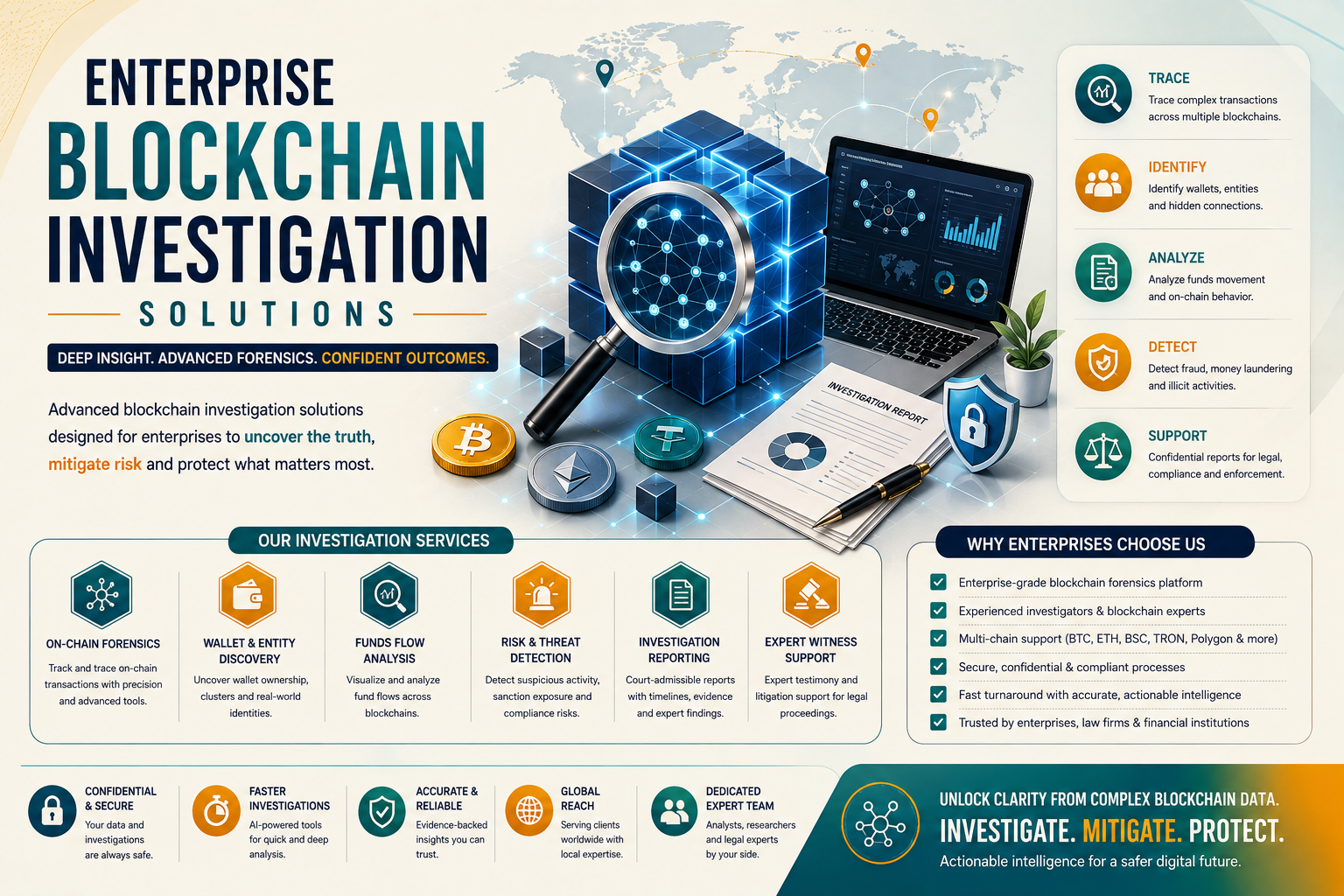
Enterprise blockchain investigation solutions are specialized forensic tools that are used by corporations, financial institutions, and law enforcement agencies to track electronic assets across distributed ledgers. They use a combination of on-chain transaction analysis, machine learning heuristics and real-world entity attribution to help detect fraud, prevent money laundering, enforce sanctions compliance and recover stolen assets in complex multi-chain ecosystems.
Introduction
The increase in cryptocurrency adoption by multinational corporations, financial institutions and decentralized networks with the need for risk mitigation has never been this great. Public blockchain ledgers provide unprecedented transparency, but the pseudonymity of wallet addresses presents a substantial operational, regulatory and security challenge for risk teams. Bad actors increasingly exploit cross-chain bridges with decentralized finance (DeFi) protocols and privacy mixers to mask illicit financial flows.
Organizations need enterprise blockchain research solutions to combat sophisticated crypto-crime. These software suites combine raw ledger data with off-chain open-source intelligence (OSINT) and proprietary attribution databases. Enterprise tools allow compliance officers and criminal investigators to keep their institutions aligned with regulations and protect their capital by mapping complex transaction paths back to real-world entities.
This guide explores the fundamental architectures, essential features, and strategic implementations of current enterprise blockchain investigation software. Enterprise solutions bridge the gap between complex cryptographic data and actionable risk management, from multi-chain tracing to court-admissible reporting.
Contents
Enterprise Blockchain Investigation Software Key Capabilities
Selecting the Right Forensics Platform for Enterprise Workflows
Enterprise Forensics Solutions Top Comparison
Real-World Case Example: Multi-Chain Fund Recovery Forensic Expert Tip
Common Errors in Crypto Investigations
Frequently Asked Questions (FAQs)
Conclusion and Strategic Next Steps
Enterprise Blockchain Investigation Software – Key Features
Today’s enterprise blockchain investigation solutions go well beyond simple block explorers by providing automated analytics, entity clustering, and pattern detection across complex ecosystems. The main basis of these forensic tools is based on automated entity attribution. Enterprise platforms use machine learning algorithms, behavioral heuristics, and vast proprietary databases to transform hexadecimal wallet strings into identifiable entities such as centralized exchanges, OTC desks, darknet markets or sanctioned actors.
Another critical capability is multi-chain trace and bridge mapping. Illicit flows of cryptocurrency are rarely confined to a single blockchain network. Malicious actors will often send assets through cross-chain bridges, DEXs and liquidity pools to break the chain of custody. More advanced enterprise solutions automatically track asset transfers between various protocols, maintaining an ongoing picture of capital flow.
Enterprise tools include automated Know Your Transaction (KYT) and Anti-Money Laundering (AML) monitoring. Financial institutions use these systems to screen incoming deposits, flag high-risk transfers in real time and generate risk scores based on direct and indirect exposure to sanctioned entities. Finally, strong case management features enable teams of analysts to annotate wallet graphs, protect evidence chains and export court-admissible forensic reports that comply with stringent regulatory requirements. These features give enterprises end-to-end visibility across global blockchain networks.
Choosing the Right Forensics Platform for Enterprise Workflows When selecting the best enterprise blockchain investigation platform, there are several key criteria specific to your organization’s technical, operational and compliance requirements that you should consider. A broad coverage of the blockchains is a necessary starting point. Enterprise risk teams also should make sure the software they choose supports not only foundational L1 blockchains, like Bitcoin and Ethereum, but also high-throughput L2 networks, Solana, TRON and emerging DeFi ecosystems where modern fraud often occurs.
Data privacy and deployment flexibility is another decisive factor. Cloud-hosted SaaS solutions do allow for quick updates and less maintenance, but law enforcement and highly regulated banks typically need on-premise or air-gapped deployments to keep sensitive case data inside secure perimeters. Organizations need to determine whether a solution offers hybrid or offline intelligence integration, in addition to custom data feeds.
Attribution quality and forensic transparency (sometimes called “glass box” methodology) are just as important. Investigators should be able to audit how wallet labels and heuristics were created so that the evidence can stand up to legal scrutiny or regulatory scrutiny. Platforms that use black-box scoring are at risk of not meeting court admissibility standards.
Forensic Analysts’ Expert Tip
Never depend on matching direct address alone when chasing complex crypto flows. Always look at indirect exposure and transaction timing heuristics. Bad actors will often pass funds through intermediary “peeling chain” wallets to dilute risk scores automated multi-hop exposure tracking will reveal the true origin and destination of suspicious capital.
Mistakes in crypto forensics
Missing indirect exposures, only seeing direct counterparty wallets, not multi-hop laundering chains.
Over-reliance on unvetted OSINT – accepting public wallet tags as true without cross-verifying the attribution methodology with proprietary intelligence.
No cross-chain bridges: Moving assets from Layer-1 to Layer-2 or off-chain breaks fund tracking.
Not capturing full cryptographic export logs for judicial or regulatory evidence. > Failure to Preserve Chain of Custody.
Endpoints as Mixers: If we assume tracing of transactions ends at the privacy pool, and not analyzing outputs after they leave the mixer.
Smart Contract Execution Skipped Logs Logs only native token transfers, skipping ERC-20 or internal contract execution events.
Comparison of Top Enterprise Forensics Solutions
|
Solution |
Primary Focus |
Best For |
Key Feature |
|
Chainalysis Reactor |
Deep Forensics & Attribution |
Regulators, Global Banks, Law Enforcement |
Extensive attribution database & multi-chain tracing |
|
TRM Forensics |
Cross-Chain Risk & AI Analytics |
DeFi Platforms, Fintechs, Crypto Exchanges |
Automated cross-chain tracing & AI Co-Agent |
|
Elliptic Investigator |
Real-time Screening & Compliance |
Financial Institutions, Crypto VASPs |
Cross-chain transaction screening & risk scoring |
|
DataWalk Crypto |
Unified Knowledge Graph |
Intelligence Agencies, Law Enforcement |
On-premise offline deployment & OSINT integration |
Real World Case Study
Multi Chain Fund Recovery The hackers who stole $15 million from a corporate treasury attempted to launder the stolen Ethereum by swapping funds on decentralized exchanges and bridging them across multiple secondary blockchains. Forensic analysts used an enterprise blockchain investigation solution with automated cross-chain tracing to map the transaction graph in real time. The software automatically tracked the assets through two liquidity protocols, identified a change-of-custody event, and flagged a destination wallet associated with a compliant centralized exchange. “The investigators immediately notified the exchange compliance team, who halted $11.2 million of the stolen assets before they could be converted to fiat currency, successfully neutralizing the breach within hours.
Enterprise blockchain investigation
Enterprise blockchain investigation software is a specialized suite of digital forensic tools developed for corporations, financial institutions and law enforcement agencies. It merges on-chain ledger data, open-source intelligence, and machine learning heuristics to track digital asset transfers, identify wallet owners, detect illicit financial activities, and produce court-admissible investigative reports across multiple blockchain networks.
FAQs
How do blockchain investigation solutions locate anonymous owners of wallets?
Although blockchains are pseudonymous, enterprise tools employ clustering algorithms, behavioral heuristics and huge proprietary databases to group addresses that are controlled by the same actor. By correlating on-chain transaction patterns with known exchange deposit addresses, darknet activity, and web scraped open source intelligence, these solutions connect cryptographic wallet strings to real world individuals and organizations.
What is KYT transaction monitoring vs forensic tracing?
KYT monitoring is an automated, real-time compliance process that screens ongoing transactions for sanctions risk and suspicious activity. Forensic tracing, in contrast, is a deep reactive or investigative process where analysts trace complex multi-hop transaction trees, analyze historical fund flows and build detailed evidentiary cases after security breaches or financial crimes.
Are blockchain investigation reports court admissible?
Yes, reports from the top enterprise blockchain investigation platforms are routinely accepted as evidence in civil and criminal court proceedings around the world. Enterprise tools deliver verifiable data lineages, timestamped ledger evidence, and transparent attribution methodologies (sometimes called “glass box” analytics) that ensure forensic findings meet rigorous legal chain-of-custody and evidentiary standards.
Can enterprise blockchain software track privacy coins and mixers?
Privacy-centric coins like Monero represent a major obstacle to investigations, but enterprise software can successfully track the use of mixers on transparent chains like Bitcoin and Ethereum. Tools use statistical analysis, timing heuristics and gas-fee correlation to track the behaviour of inputs to the mixer and outputs from the mixer and can often identify withdrawal wallets and exchange endpoints.
How are financial institutions integrating blockchain tools into their workflow?
Blockchain investigation software used by financial institutions and integrates with powerful REST APIs and webhooks. These links connect on-chain intelligence directly to existing Anti-Money Laundering (AML) software, Security Information and Event Management (SIEM) systems and core banking platforms. This allows automatic risk scoring of customer deposits, instant alert creation and a one-stop case management.
Conclusion
As the digital asset landscape matures, enterprise blockchain investigation solutions have moved from niche forensic utilities to become essential pillars of institutional risk management and financial intelligence. Visualizing multi-chain transactions, accurately attributing wallet clusters and automating real-time risk scoring enables enterprises, banks and law enforcement agencies to stay ahead of sophisticated threat actors. Replacing piecemeal manual transaction lookups with enterprise-grade investigative infrastructure safeguards organizations’ financial capital and ensures strict compliance with evolving global regulations.
The right software choice is determined by a clear assessment of your organization’s required blockchain coverage, data privacy preferences, and workflow integration needs. Get a free audit of your crypto compliance stack today to improve your corporate risk posture and protect your digital asset operations. Schedule a tailored platform demonstration with our forensic intelligence experts and discover how custom enterprise blockchain investigation solutions will enhance the protection of your organization from crypto-based financial crime.
