.png)
1. What is Utility Token?
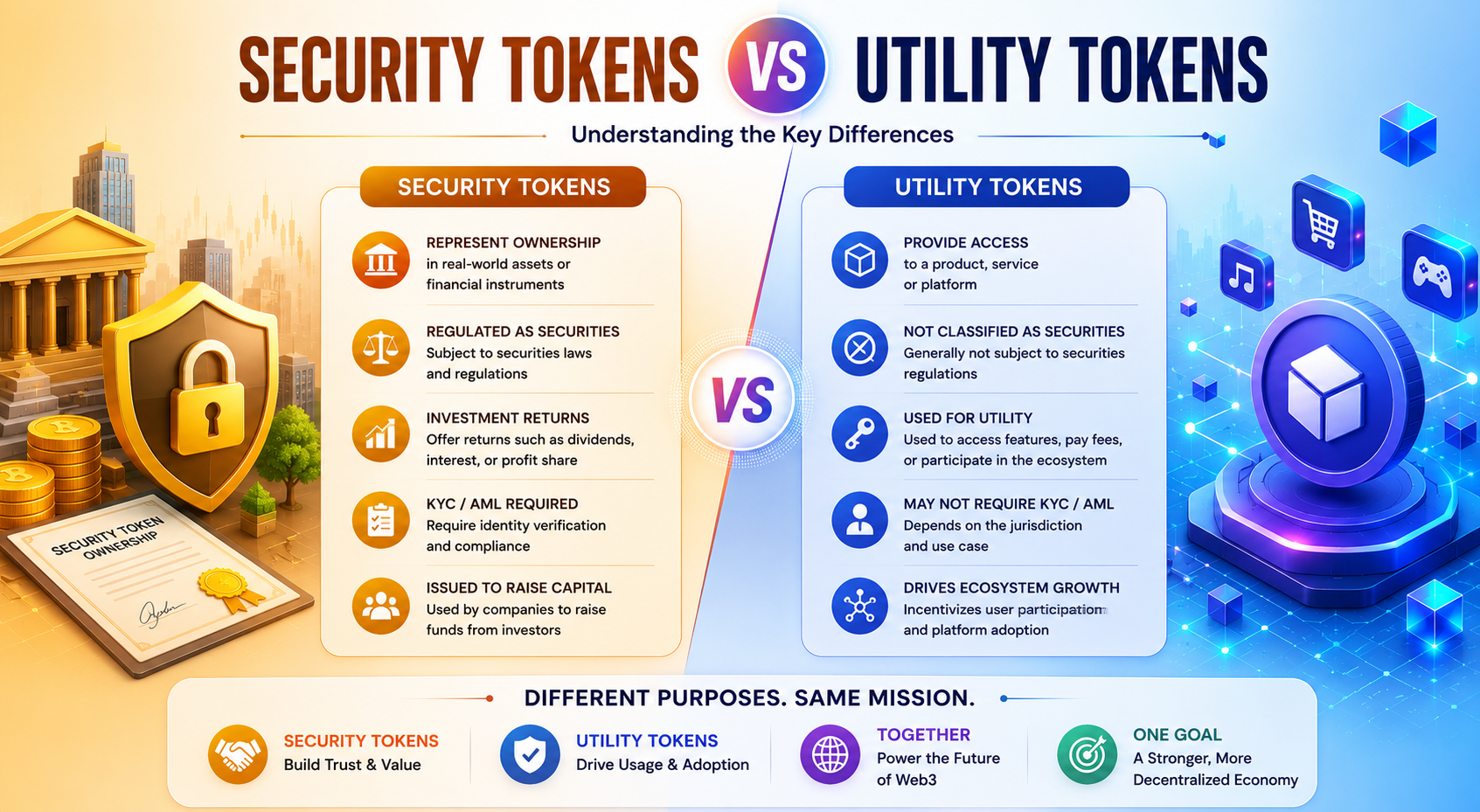
A utility token is a token that is built on a blockchain that gives the owner access to a product, service or function on a blockchain. Its concept is to be used functionally to pay for transaction fees, access decentralized apps (dApps) or participate in the management of the platform – not as an investment vehicle.
2. What is a security token?
A security token is a digital asset that symbolizes ownership, investment rights, profit sharing rights, debt or any other financial interest in an underlying asset or business. Security tokens are frequently regarded as securities since people usually buy them with the expectation of profiting from them.
3. Token Classification:
Token classification is a process of legal and regulatory classification of a digital token based on its functionality, economic attributes, rights granted to holders and the appropriate legislation. The appropriate classification helps to determine if token should be treated as a utility token, security token, payment token or any other category.
4. What Is Tokenomics?
Tokenomics is the economic design of a digital token. This comprises the token’s quantity, distribution & issuance, the token’s utility, governance systems, incentive models, and demand drivers. Good tokenomics are very much needed for a blockchain project to be sustainable and profitable in the long run.
5. What is a smart contract?
A smart contract is a contract that lives on a blockchain and that automatically executes specific actions if the conditions are met. Smart agreements allow automatic, safe and transparent transactions without intermediaries.
6 Tokenisation
Tokenization is the process of converting ownership rights or interests in real world or digital property into digital tokens on a blockchain. These assets may include real estate, shares in a firm, commodities, intellectual property, pieces of art or other valuable assets and may be more available on a fractional basis.
7. What is Howie Test?
The Howey Test is a legal test developed by the U.S. courts to decide whether a transaction is an investment contract, and therefore a security. Though from US, it has had an impact on token classification and securities research in many nations throughout the world.
Article
As blockchain technology continues to disrupt finance and digital commerce, digital tokens have emerged as an essential building stone of the Web3 ecosystem. Tokens enable firms to raise capital, reward users, facilitate transactions, and build decentralized communities from DeFi applications to games to tokenized assets. But not all tokens are equally good. One of the biggest legal distinctions in the blockchain industry is whether a token is classified as a utility token or a security token.
This is much more than a terminology issue. It identifies the relevant regulatory regime for the token, the obligations of the issuer and the rights of the token holders. For example, a token misclassified could lead to regulatory inquiries, financial penalties, investor lawsuits and restrictions on fundraising. As such, it is important for the founders to evaluate the legal nature of their token before launching the token on the market. A utility token is a token that allows access to a product, a service or a capability within a blockchain ecosystem. Users can interact with a decentralized application, pay transaction fees, participate in governance, unlock premium features or access digital services. Utility tokens are not an investment instrument, they exist to do one thing. Its value is generally linked to usage and popularity of the underlying platform at group tech legal.
Security tokens represent an investment interest in the underlying company or asset. Security tokens may entitle holders to rights such as dividends, profit sharing, participation in ownership interests, participation in income or other financial benefits. The tokens are often treated as securities because the purchasers are typically buying these tokens with a realistic expectation of profit from the efforts of the issuer or the management team. Issuers of security tokens could be subject to registration and disclosure requirements to investors, licensing and ongoing regulatory reporting. Many blockchain entrepreneurs are under the impression that they can simply call a token a “utility token” to sidestep securities laws.
It’s not about what it’s called but what it does and what the economic substance is that the regulators really look at. When determining the legal classification of a digital asset, a variety of elements are considered, such as marketing materials, tokenomics, investor expectations, governance rights and revenue sharing schemes. The legal distinction between utility tokens and security tokens has substantial business implications. Companies that want to build decentralized ecosystems, engage users or stimulate interactions on a platform usually find utility tokens more flexible. Security tokens are a legitimate way to raise funds and offer tokenized investment options but also carry a wider set of regulatory obligations. As governments roll out unique virtual asset regimes, corporations must examine how their token will be treated in each jurisdiction in which it is issued or traded. Legal counsel should thoroughly vet the concept before founding teams issue a token.
This requires evaluating the utility of the token, the rights it gives to holders, the token distribution mechanism, the governance model, the finance model and the intended usage of the token within the ecosystem. In addition, it is worth checking the project’s whitepaper, website, promotional material and token sale paperwork to ensure they depict the token’s functionality appropriately and do not accidentally set expectations of financial returns that might trigger securities regulation.
Compliance is not an obstacle to innovation but a competitive advantage. A well-designed currency that adheres with the right legal standards can enhance investor confidence, simplify exchange listings, strengthen banking relationships and lower regulatory concerns. As more nations across the world are tightening the comprehensive regulation of online assets, organizations that focus on legal compliance from the outset are more likely to achieve long-term success and worldwide expansion.
At the end of the day, the rights granted, the purpose and the economic reality of the transaction differentiate a utility token from a security token. Blockchain initiatives should not label tokens by technical design or marketing terminology. Instead, enterprises should seek legal advice, conduct jurisdiction-specific regulatory evaluations and establish a robust compliance strategy before launching their token. This allows producers to cut down on legal uncertainty and create trusted and successful web3 businesses in an increasingly regulated digital economy.
Frequently Asked Questions
1. What is the main difference between a utility token and a security token?
A utility token provides access to products or services within a blockchain ecosystem, whereas a security token represents an investment interest or ownership rights and is generally subject to securities regulations.
2. Can a utility token become a security token?
Yes. If the token’s functionality, marketing, or economic characteristics change such that purchasers reasonably expect profits based on the efforts of others, regulators may classify it as a security.
3. Does calling a token a “utility token” guarantee it is not a security?
No. Regulators examine the substance and economic reality of the token rather than the terminology used by the issuer.
4. Are security tokens legal?
Yes. Security tokens can be legally issued, provided they comply with applicable securities laws, disclosure obligations, licensing requirements, and investor protection regulations.
5. Why is legal advice important before launching a token?
Legal advice helps determine the appropriate token classification, identify regulatory obligations, prepare compliant documentation, and reduce the risk of enforcement actions.
6. Can utility tokens be traded on cryptocurrency exchanges?
Many utility tokens are listed on cryptocurrency exchanges, subject to the exchange’s listing criteria and applicable regulations in relevant jurisdictions.
7. How can founders reduce regulatory risks when issuing tokens?
Founders should conduct legal due diligence, obtain regulatory advice, structure tokenomics carefully, prepare comprehensive legal documentation, and ensure ongoing compliance with applicable laws.
