

Crypto token classification sits at the centre of launch planning in 2026, with MiCA active and the GENIUS Act reshaping U.S. enforcement. I have seen projects stopped at the draft stage when the token legal framework was weak. Regulators now study intent, rights, and value flow before code is deployed. This guide shares a framework used in filings, not theory.
- – Start with token rights, not marketing language.
- – Test structure under MiCA compliance and Howey Test together.
- – Document assumptions in whitepapers, board notes, and legal memos early.
Classification starts with substance, not labels.
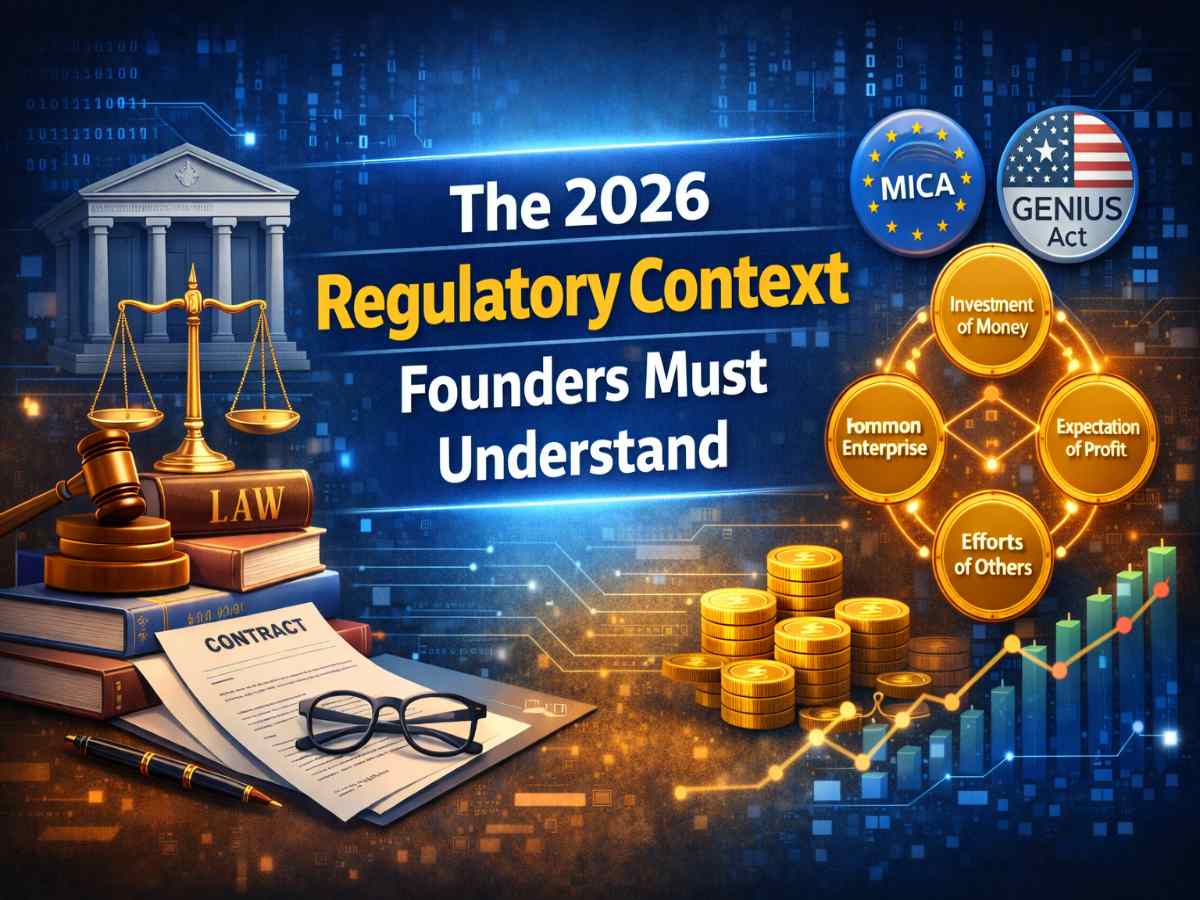
The 2026 Regulatory Context Founders Must Understand
Navigating the current crypto regulation update requires moving beyond old legal playbooks that relied on vague guidance. Today, token classification is strictly defined by active token enforcement and concrete statutes like the GENIUS Act. Your project’s legal standing now depends on real-world application rather than just theoretical whitepaper promises.
Why the “Utility Token” Era Effectively Ended
Regulators now ignore what you call your asset and focus entirely on its economic reality. Under MiCA 2026, authorities use functional classification to see if your token acts as a financial instrument. If your community expects a return, the “utility” label will not protect you from a securities designation.
- – Marketing is Evidence: Public Telegram chats and Twitter hype now carry more legal weight than your formal legal disclaimers.
- – Secondary Market Control: If you actively manage liquidity to maintain price floors, you are likely operating a regulated exchange.
- – Centralised Triggers: Any “emergency switch” or team-controlled treasury signals a lack of true decentralisation to auditors.
Substance-Over-Form as the Dominant Legal Lens
The “substance-over-form” doctrine means the law looks at the actual relationship between the founder and the buyer. Even if your documents say “not an investment,” the courts will look at whether you used the funds to build the ecosystem. In 2026, a token’s legal soul is determined by how it flows through the economy, not its name.
Practitioner Insight: Structural alignment beats clever wording; if it looks and trades like a stock, the law will treat it as one.
The Token Classification Spectrum (Not a Binary Test)
Security vs utility token analysis works best when tokens are seen on a spectrum. Most tokens mix traits that shift with design and control. Regulators focus on real use and user reliance, not whitepaper labels.
Securities-Like Tokens (Expectation & Reliance)
Tokens move into securities territory when buyers expect profits from others’ work. Control, yield, and reliance outweigh technical structure.
- – Centralised upgrades or treasury control
- – Passive yield without user action
- – Price-led promotion
Example: A pre-launch app token where rewards depend on a core team usually attracts securities scrutiny.
Functional Utility Tokens (Consumption-First Design)
True utility tokens serve a live need at purchase. Use must come before any value story.
Necessary but Not Sufficient Conditions:
- – Immediate protocol access
- – Limited, defined function
- – No profit messaging
Governance & Hybrid Tokens (The Grey Zone)
Governance token law is the most complex here. These tokens often claim decentralisation before reaching a decentralisation threshold.
Why Regulators Scrutinise These Most:
- – Votes affect fees or reserves
- – Insider voting dominance
- – Governance tied to price
| Token Feature | Likely Classification | Regulatory Focus |
| Passive yield or staking rewards | Security / ART | SEC / MiCA Title III |
| Immediate protocol consumption | Utility | MiCA Title I |
| Governance + value accrual | Hybrid (High Risk) | SEC / ESMA |
| RWA peg or reserve backing | Asset-referenced token | MiCA / VARA |
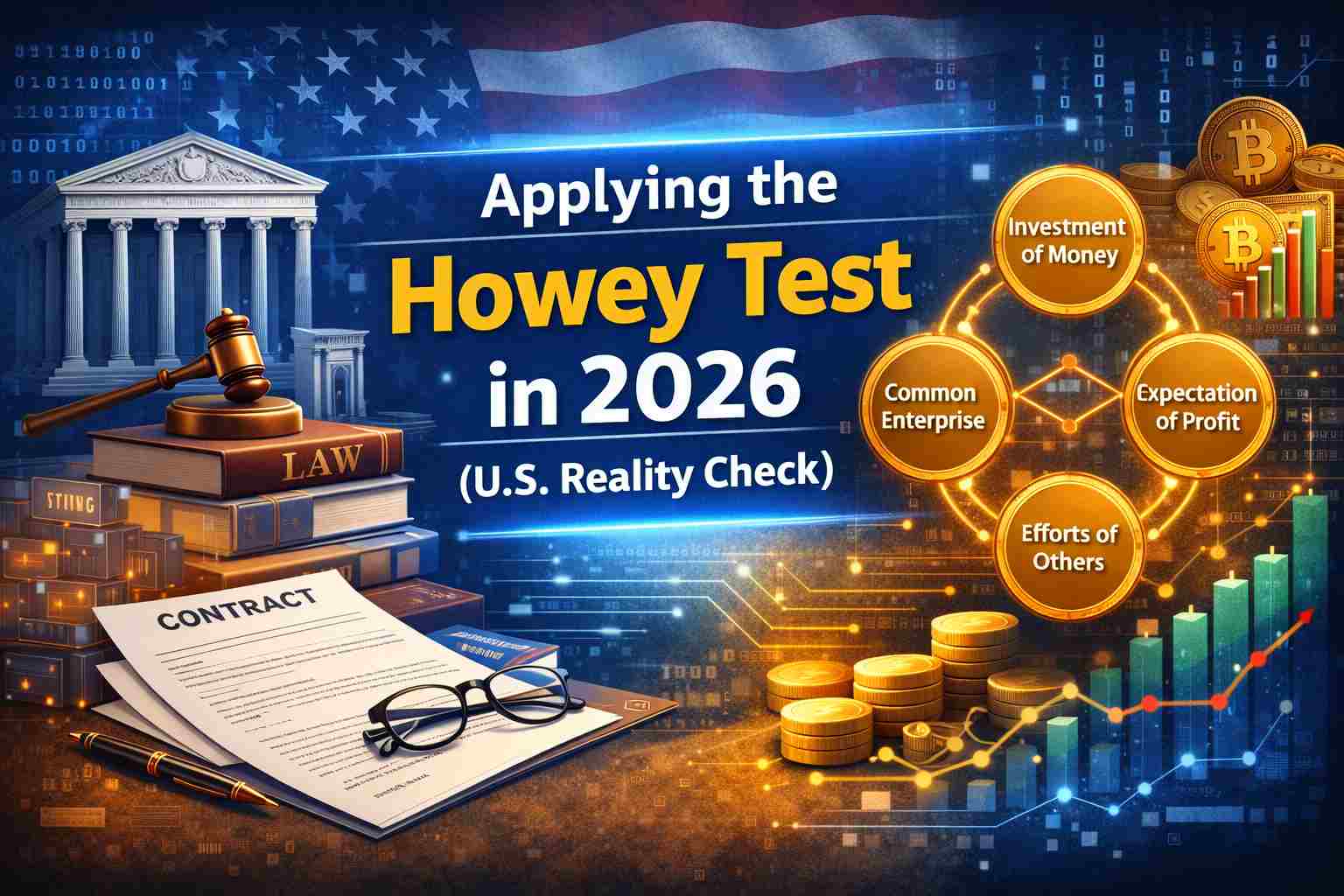
Applying the Howey Test in 2026 (U.S. Reality Check)
Howey Test crypto analysis is still the base of U.S. token regulation, but its use in 2026 is practical, not theoretical. Regulators look at real token behaviour, not whitepaper promises. In my experience, enforcement focuses on how tokens move, earn, and are sold.
Breaking Down the Four Prongs in Token Context
- Investment of money now includes indirect value like stablecoins, locked rewards, or work exchanged for tokens. “Free” access claims fail when users still give value.
- A common enterprise often exists through shared treasuries, pooled staking, or protocol revenue. Many projects fail here when outcomes move together.
- Expectation of profit appears when holders expect price growth or yield. An investment contract token does not need dividends; belief in appreciation is enough.
- Efforts of others exist when a core team or foundation drives upgrades, listings, or incentives. Passive holders relying on active builders meet this prong.
Where Token Projects Usually Fail the Test
- – Marketing language hinting at returns
- – Treasury-controlled liquidity supporting price
- – Roadmaps tied to value expansion
Pattern We Repeatedly Observe: teams design for growth first, then argue utility later, very often.
MiCA’s Functional Classification Model (EU Focus)
MiCA token classification sits within EU crypto law and changes how projects are judged. Instead of asking what a token is called, regulators look at what it does. Each category triggers clear duties, so design choices quickly turn into legal obligations.
Utility, ARTs, and EMTs Explained Practically
Utility tokens are treated lightly when they stay inside a closed ecosystem. Once value stability or redemption promises appear, the token moves into a stricter bucket. This practical split matters before public sale.
- – Utility tokens: access use, no value promise
- – ARTs: asset basket reference, managed reserves
- – EMTs: single fiat peg, guaranteed redemption
From a compliance view, ARTs and EMTs carry a heavy operational load. Reserve audits, governance rules, and daily reporting are mandatory. Teams underestimate cost and timing, highlighting the Top 10 Legal Risks When Outsourcing to India.
The Whitepaper as a Legal Document
Under EU crypto law, the MiCA whitepaper is read like evidence, not marketing. Supervisors compare claims with token mechanics and backend controls. Any gap raises trust issues and formal questions. Many founders learn this only after submission.
- – Unclear redemption flow and timing
- – Weak risk section copied from other projects
- – Token rights not matching smart contract logic
The 3-Step Token Classification Stress Test
Before launching a new token, internal teams often run a practical review to spot risks early. The 3-Step Token Classification Stress Test is a straightforward model that checks if your token could raise regulatory or compliance issues, helping you act before public scrutiny.
Step 1 — Profit Expectation vs Consumption
Assess why users join your token ecosystem. Are they there for utility, or purely for gains? This is similar to how securities analysts judge investor intent.
- – Yes: Users engage with the product, platform, or service.
- – No: Users engage mainly to flip tokens for profit.
If the answer leans toward “No,” consider adjusting the token design or communication to highlight real utility.
Step 2 — Secondary Market Velocity
Liquidity is vital, but how fast tokens move on exchanges can reveal speculative intent. Track this carefully:
- – Set realistic liquidity targets aligned with token use.
- – Identify which exchanges will list your token and why.
- – Monitor rapid trading spikes as red flags.
- – Use vesting schedules to slow down speculative flips.
Caution: A token listed on multiple exchanges with sudden trading bursts may attract unwanted regulatory attention.
Step 3 — Narrative & Messaging Audit
Compare your public materials: whitepaper, website, Discord, and social media. Check for alignment.
- – Claims match the product roadmap
- – Use cases are clearly explained
- – Marketing avoids promises of guaranteed returns
- – Inconsistency = Risk Multiplier
This step ensures your public statements don’t contradict internal intent, reducing enforcement risk.
Operational Consequences of Misclassification
Shift focus from theory to real-world impact. Misclassifying a token can create costs far beyond paperwork—it can affect your operations, reputation, and long-term viability.
Compliance Cost vs Enforcement Cost
| Action | Typical Cost Range | Risk Profile |
| Legal classification & opinion | Predictable | Preventive |
| Enforcement response | Exponential | Existential |
Even though getting a legal opinion feels expensive upfront, it is controlled and predictable. Ignoring proper classification, however, exposes projects to crypto enforcement risk, where penalties, forced shutdowns, or retroactive obligations can be devastating.
The table shows that proactive compliance keeps token compliance costs manageable and prevents a situation where enforcement costs spiral out of control. For teams, addressing the Top 5 Legal Challenges Every Crypto Startup faces means investing in early guidance, which is far cheaper and safer than reacting to government action later
Emerging 2026 Classification Risks Most Founders Miss
Forward-looking risk intelligence is becoming essential for founders in crypto. As AI-driven protocols evolve, new classification challenges are appearing that can affect legal and financial responsibilities. Understanding these risks now helps teams avoid costly missteps later.
AI-Managed Tokens & Autonomous Protocols
AI agent tokens and autonomous crypto systems create grey areas in regulation. Even when operations are automated, accountability still often falls on the humans behind them. Founders need to anticipate where liability may land before problems arise.
- – Regulators are unsure whether AI token actions can be considered independent or if human oversight remains legally responsible.
- – DAO liability continues to be debated, especially when autonomous protocols make decisions without direct human intervention.
Identifying these gaps early allows teams to design structures that reduce risk while staying innovative.
visit us:- Connect with YourTechLegal on social media for expert tech and legal updates.
Final Perspective — Classification Is a Design Decision
Token design compliance starts at the drawing board, not after launch. How a crypto product is structured and presented often determines its legal classification, making thoughtful design and clear messaging essential from day one. Legal analysis, therefore, becomes part of product architecture, guiding features and interactions rather than reacting to them.
Integrating compliance into the core design helps prevent costly reworks and aligns the project with evolving regulations. By treating legal strategy as an ongoing architectural choice, teams can confidently navigate market entry while protecting users and stakeholders. As regulators gradually harmonise rules, projects that embed compliance from the start will be best positioned for smooth adoption across jurisdictions.
Frequently Asked Questions About Crypto Token Classification
How do regulators determine if a token is a security in 2026?
Regulators mainly check if the token gives holders a profit expectation from someone else’s efforts. Tokens sold for investment purposes with centralised management often fall under security rules. Clear documentation and purpose can reduce legal risk.
What differentiates a utility token from a governance token legally?
Utility tokens give access to a product or service, while governance tokens grant voting rights on platform decisions. Regulators focus on how much control and profit potential the holder has. Accurate labelling in whitepapers helps prevent misclassification.
How does MiCA classify asset-referenced and electronic money tokens?
MiCA treats asset-referenced tokens as stablecoins backed by multiple assets, while e-money tokens are pegged to a single fiat currency. Each has distinct licensing and reporting requirements. Founders must follow specific capital and transparency rules.
What are the common pitfalls founders face when drafting a whitepaper?
Many founders exaggerate future returns or fail to explain token use clearly. Leaving legal disclaimers vague or skipping compliance checks can attract scrutiny. A precise, realistic whitepaper builds trust and avoids regulatory trouble.
How does token decentralisation impact legal classification?
More decentralised tokens are less likely to be seen as securities because no single party drives profits. Regulators examine governance, control, and network distribution closely. True decentralisation requires both technical setup and transparent policies.
Are AI-managed or autonomous tokens treated differently under current law?
AI or self-executing tokens don’t have special exemptions yet. Regulators focus on who benefits from the token and who is responsible for its actions. Clear operational rules and liability assignment are key to staying compliant.